
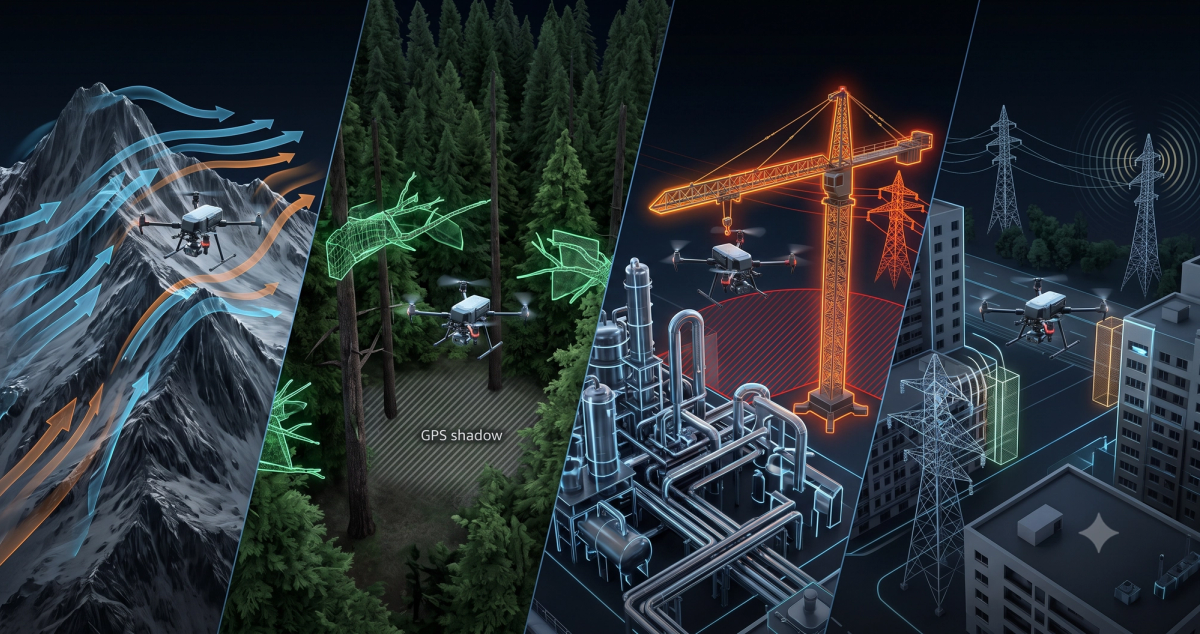
A drone that performs well at one site does not automatically perform well at another.
Autonomous drone missions are shaped by the environment around them. Change the site, and the risk picture changes too. That is why every new deployment location should be treated as a new operational context, not a repeat of the last successful flight.
Site Conditions Change Mission Behaviour
Drone systems depend on assumptions about the world around them. The route, obstacles, terrain, visibility, communications environment, and local weather conditions all influence mission performance.
Even when the aircraft, software, and mission objective stay the same, the site can introduce new risks.
A route that is straightforward in one location may become complex in another because of buildings, vegetation, moving vehicles, restricted zones, or uneven terrain. A perception system that performs well in one visual environment may face more difficult conditions somewhere else.
The mission has changed because the site has changed.
The Hidden Risk Of Familiar Systems
One of the biggest risks in autonomous operations is familiarity.
When a system has performed well before, teams may naturally feel more confident using it again. That confidence can be useful, but it can also hide site-specific risk.
Previous success proves something about the previous mission. It does not prove that the next site has the same operating conditions.
For autonomous drone teams, this distinction is important. Each new site can affect:
- Wind exposure and turbulence
- Obstacle proximity and route complexity
- GPS quality and positioning reliability
- Communications strength and coverage
- Sensor visibility and perception confidence
- Emergency landing options
- Interaction with people, vehicles, or other site activity
These factors need to be assessed before flight, not discovered during deployment.
Why Generic Testing Is Not Enough
General platform testing is essential, but it cannot answer every site-specific question.
A drone may have been tested extensively in controlled environments, test ranges, or previous customer sites. Those tests help establish baseline capability, but they do not fully describe how the system will behave in a new operational environment.
Site-specific validation fills that gap. It helps teams understand how the mission behaves when the actual deployment context is represented.
That does not mean every risk can be predicted perfectly. It means teams can identify obvious failure points, stress the mission under relevant conditions, and make better decisions before the aircraft is in the air.
Resetting The Risk Picture
Every new site should reset the operational question.
Instead of asking, “Has this drone worked before?” teams should ask, “Has this mission been validated for this site?”
That shift is important for scalable autonomous deployment. It helps teams avoid relying on assumptions from previous locations and encourages a more disciplined approach to mission planning.
It also supports better communication with customers and stakeholders. A site-specific risk picture is easier to explain, review, and act on than a general claim about platform performance.
Safer Deployment Starts Before Arrival
Autonomous drone missions are not only about what happens during flight. They are also about how well the mission has been understood beforehand.
By validating each new site before deployment, drone teams can identify risks earlier, adapt the mission where needed, and build confidence in the operating envelope.
Every site is different. Treating it that way is not a barrier to scale. It is how autonomous drone operations become safer, more repeatable, and more credible.