

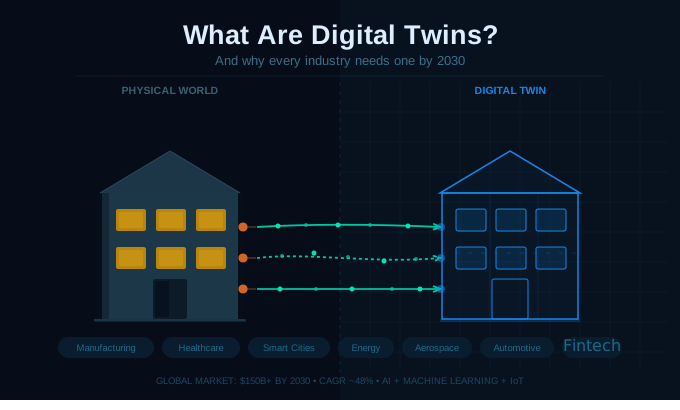
Imagine building a new aircraft, redesigning a hospital ward, or planning a smart city district — and being able to test every decision in a perfect virtual copy before spending a single pound on physical materials. That is, in essence, what a digital twin makes possible.
Digital twin technology has moved from a niche concept used by NASA in the 1960s to one of the fastest-growing sectors in enterprise technology. With the global market projected to grow from roughly $21 billion in 2025 to well over $150 billion by 2030, the question is no longer whether digital twins will reshape your industry — it is whether you will be ready when they do.
This article breaks down exactly what digital twins are, how they work, which industries are being transformed right now, and why 2030 represents a critical deadline for adoption.
What Is a Digital Twin?
A digital twin is a dynamic, real-time virtual replica of a physical object, system, or process. Unlike a static 3D model or a CAD drawing, a digital twin is continuously updated with live data from the real world — through sensors, IoT devices, cameras, and machine learning models — so that its virtual state always mirrors its physical counterpart.
The concept was first formalised by Dr Michael Grieves at the University of Michigan in 2002 in the context of product lifecycle management, though NASA had used precursor versions decades earlier to simulate spacecraft in real time.
At its core, every digital twin has three components:
- The physical entity (the real-world object or system)
- The virtual model (the digital replica, often including 3D representations)
- The data connection (real-time flows linking the two, often powered by AI and ML)
KEY INSIGHT
A digital twin is not simply a 3D model. It is a living, breathing data entity that evolves alongside its physical counterpart — enabling prediction, simulation, and optimisation at a level static models cannot match.
Digital Twins by the Numbers
$150B+ Projected market value by 2030
~48% Compound annual growth rate (CAGR)
59% of executives plan adoption by 2028
Sources: MarketsandMarkets, Grand View Research, ResearchAndMarkets (2025)
How Do Digital Twins Actually Work?
The power of a digital twin lies in the convergence of several technologies that are only now reaching maturity simultaneously:
1. IoT Sensors & Real-Time Data Collection
Physical assets are equipped with sensors that continuously stream data — temperature, pressure, vibration, location, energy consumption — into the digital model. This creates a live data feed that keeps the virtual twin synchronised with reality.
2. Artificial Intelligence & Machine Learning
Raw sensor data alone is insufficient. AI and machine learning models interpret that data to identify patterns, anomalies, and predicted failure points. This is what transforms a passive model into an active, predictive tool. AI-driven digital twins are the fastest-growing segment, with a projected CAGR of over 25% through 2030.
3. 3D Modelling & Visualisation
High-fidelity 3D models form the visual and spatial backbone of most digital twins. Advances in automated 3D model generation — including photogrammetry, LiDAR scanning, and AI-based reconstruction — are dramatically reducing the time and cost of creating these models.
4. Cloud Computing & Edge Processing
Digital twins generate enormous volumes of data. Cloud platforms provide the scalable storage and compute power needed to run simulations, while edge computing allows time-critical processing to happen close to the physical asset — reducing latency for real-time decisions.
Industries Being Transformed by Digital Twins
Manufacturing & Industry 4.0
Manufacturing is the most mature digital twin market and the largest by revenue. Smart factories use sensor-rich environments to create real-time digital twin representations of entire production lines, enabling AI-driven simulations for logistics forecasting, robot path planning, defect inspection, and preventive maintenance.
- Gartner predicts a 10% improvement in effectiveness for industrial companies using digital twins
- IDC research indicates that businesses investing in digital twin technology see a 30% improvement in cycle times of critical processes
- Siemens and NVIDIA have partnered to deliver real-time factory digital twins that run AI models up to 25 times faster than previous generations
DFDB Healthcare & Life Sciences
The healthcare segment is expected to register the highest growth rate of any sector — over 52% CAGR — through 2030. Digital twins are being used to model patient physiology, simulate surgical procedures, test medical devices in virtual environments before manufacture, and personalise treatment plans.
- Drug digital twins allow scientists to simulate the effects of formulation changes before physical trials
- Patient digital twins enable clinicians to test interventions on a virtual model before applying them to the real patient
- Medical device developers use digital twins to reduce the cost and risk of physical prototyping and regulatory testing
Smart Cities & Infrastructure
Cities around the world are deploying digital twins to plan and optimise urban infrastructure. By merging IoT data, geospatial sensors, historical records, and machine learning predictions, city planners can visualise and test decisions before committing physical resources.
- Traffic and pedestrian flow simulation using CCTV and IoT sensors reduces congestion and infrastructure costs
- Energy management digital twins help buildings — which account for approximately 40% of global energy consumption — significantly reduce waste
- The European Commission's DestinE project is building a global digital Earth twin to predict climate systems and extreme weather events
Energy & Utilities
In oil and gas, digital twins of drill rigs, pipelines, and refineries provide real-time monitoring and predictive insights. Companies using digital twins in this sector have seen unexpected work stoppages drop by as much as 20% — representing savings of approximately £3 million per rig per month.
Automotive & Aerospace
The automotive and transportation segment held the largest share of the digital twin market in 2024, driven by the shift to electric and autonomous vehicles. Digital twins allow manufacturers to simulate complex vehicle systems in real time — from battery thermal management to autonomous driving algorithms — long before physical prototypes are built.
Why 2030 Is the Critical Threshold
The urgency around 2030 is not arbitrary. Several converging trends are creating a window of competitive advantage that will close quickly:
TREND 1
5G rollout is enabling the always-on, ultra-low-latency data connections that real-time digital twins require at scale.
TREND 2
AI model capability is compounding rapidly. Digital twins built today will be dramatically more powerful in 3-5 years as the underlying models improve.
TREND 3
Regulatory pressure is intensifying. EU sustainability directives and carbon reporting requirements are driving enterprises to adopt monitoring and simulation tools — digital twins being the most capable.
TREND 4
Cost of entry is falling. Automated 3D model generation, cloud-native platforms, and DTaaS (Digital Twin as a Service) models are making the technology accessible to mid-market businesses for the first time.
Critically, nearly half of IT decision-makers are still unfamiliar with digital twin technology — but 59% of executives across industries plan to integrate it into their operations by 2028. The window between awareness and action is where competitive advantage is built.
The Rise of Digital Twins as a Service (DTaaS)
One of the most significant shifts in the market is the move from bespoke, capital-intensive digital twin implementations to cloud-native, subscription-based DTaaS models.
Traditional digital twin deployments required significant upfront investment in sensors, infrastructure, and specialist engineering teams — placing the technology out of reach for all but the largest enterprises. DTaaS changes this by:
- Eliminating large upfront capital expenditure in favour of predictable monthly or annual subscriptions
- Providing pre-built connectors for common industrial hardware and data sources
- Enabling rapid prototyping — deploying a working digital twin in weeks rather than months
- Offering scalable compute through cloud infrastructure, with no need to manage on-premises servers
This democratisation is precisely what is driving the accelerating adoption among small and medium-sized enterprises — a segment expected to grow at the highest CAGR through 2030.
The Role of AI and Machine Learning in Next-Generation Digital Twins
The most transformative development in the digital twin landscape is the deep integration of artificial intelligence and machine learning — moving digital twins from descriptive (what is happening?) to predictive (what will happen?) and prescriptive (what should we do?).
Key AI-powered capabilities now being embedded into digital twins include:
- Automated 3D model generation from point clouds, photographs, or LiDAR scans — dramatically reducing setup time and cost
- Anomaly detection algorithms that flag deviations from expected behaviour in real time
- Predictive maintenance models that forecast equipment failure days or weeks in advance
- Simulation of 'what if' scenarios at scale, including stress-testing designs under thousands of simulated conditions simultaneously
- Natural language interfaces that allow non-technical users to query and interact with complex twin models
Challenges and Considerations
Digital twin adoption is not without hurdles. Understanding these challenges is essential for organisations planning their implementation strategy:
- Data quality and availability: Digital twins are only as accurate as the data that feeds them. Organisations with fragmented, siloed data infrastructure face significant integration challenges.
- Interoperability: A lack of common standards across platforms, sensors, and software providers makes it difficult to connect twins across systems or supply chains.
- Security and privacy: Real-time data flows between physical and virtual environments create new attack surfaces and raise important questions about data sovereignty.
- Talent: Skilled professionals who can build, operate, and interpret digital twin systems remain in short supply — though job listings featuring 'digital twin' have grown by 11% year on year.
Conclusion: Digital Twins Are No Longer Optional
Digital twins began as a tool for space agencies and defence contractors. By 2030, they will be as fundamental to enterprise operations as ERP systems are today — the backbone through which physical assets, business processes, and human decisions are understood, optimised, and future-proofed.
The organisations that act now — investing in the data infrastructure, the platform relationships, and the internal skills to leverage digital twin technology — will hold a substantial advantage over those that wait. The market is growing at nearly 48% per year. The technology is maturing rapidly. And the cost of entry has never been lower.
The question is not whether your industry needs a digital twin. It is whether you will build one before your competitors do.